Jeffrey and I returned from our trip to Krakow last week. We enjoyed exploring the city's Old Town and I'm looking forward to writing more about that, but the main purpose of this trip was to visit Auschwitz I and Auschwitz II-Birkenau. On our ride to the site, we had trouble describing our emotions in an appropriate way. Excited wasn't right. It sounded macabre to say we were looking forward to it even though we had been planning this tour for weeks. Looking back, we were anxious, even nervous, to walk the grounds of a site responsible for one of humanity's most horrifying tragedies - the murder of at least 1.1 million innocent people.
We arrived and joined a group of about 10 others and met our guide. Even though having a guide is mandatory during the high season, I would definitely recommend them. Our guide also encouraged us to take pictures, acting not as tourists but witnesses to the tragedies that took place here. We had tried to reeducate ourselves about the camp's history, but hearing the descriptions and seeing them at the same time made it easier to take everything in. We began our tour by walking under the infamous gate with message, Arbeit Macht Frei. Cruelly, this message means "Work Brings Freedom".

Victims were transported here from all over Europe, even from as far away as Norway. Auschwitz I used the grounds of prewar Polish barracks to first hold Poles in 1940, a race the Nazis believed to be sub-human and were to be used as slaves to the new regime. Although Jews were the preferred scapegoat of the Nazis for the world's problems, for almost 2 years the majority of the prisoners at Auschwitz were Poles. During this time, the camp functioned primarily as a concentration camp where death was brought on slowly from deliberate inhuman conditions and starvation. The double, electrified barbed-wire fence surrounding the camp divided life and death.

As conditions worsened in Jewish ghettos across Europe, the Nazi administration saw the growing number of corpses as a sanitation problem. Additionally, the Nazis found the psychological hardship was too great for SS men to perform mass executions of Jews (regardless of gender or age) by shooting them like the victims in German-occupied areas of the Soviet Union in June 1941. In January 1942, Hitler detailed his "final solution of the Jewish question", the Jewish ghettos were being liquidated, and Auschwitz, among others became a death camp for the extermination of European Jews and others whom the Nazis considered "undesirable".

Seeing those numbers is appalling, but it can also be a little impersonal because it's so hard to imagine. The museum tries to solve this with exhibits solely displaying the possessions of the victims like a room of shoes, hairbrushes, and suitcases. This was only a fraction of the belongings stolen from the Jews as they stepped off the cattle cars, mistakenly thinking the worst was behind them. Most disturbing was the room displaying 2 tons of human hair, primarily women's. More than 7 tons were found by the liberating army. Why was it kept? To make blankets and jackets for the Nazis. Auschwitz was truly a factory of death.
 |
| More than 80,000 shoes of victims |
Also on display were the belongings of children as more than 230 thousand children under the age of 18 were deported to Auschwitz. Only 700 survived.
 |
| Hungarian Jews arriving at Auschwitz |
After the "final solution" was imposed, most Jews deported to Auschwitz were sent to gas chambers, especially women with children. This process was done quickly so as not to raise panic. The museum even displayed pictures of families walking calmly, arm-in-arm toward the doors of the gas chambers. Those selected for work could be sent to their deaths at any time through other random selections. In the picture below, I am standing on the same spot that prisoners stood for selections during which SS doctors classified people as fit for work, fit for experimentation, or fit for death.
 |
| Another view of the selection and roll-call area |
Of those chosen for work, it was imperative that they follow the rules or they would be placed in Block 11. A prison within a prison. It was the most feared block and no one ever came out alive. People were tortured here in starvation cells, darkness cells, and standing cells. If the crime was punishable by immediate death, prisoners were taken to the wall in the courtyard between Blocks 10 and 11 and were shot. One such victim of this block was Maksymilian Kolbe. A prisoner from Kolbe's block managed to escape, so the Nazis punished the remaining inmates by selecting 10 of them to be put in a starvation cell until they died. Kolbe offered to replace a man who had expressed concern about who would care for his family. The Nazis agreed. The man Kolbe replaced survived the Holocaust.

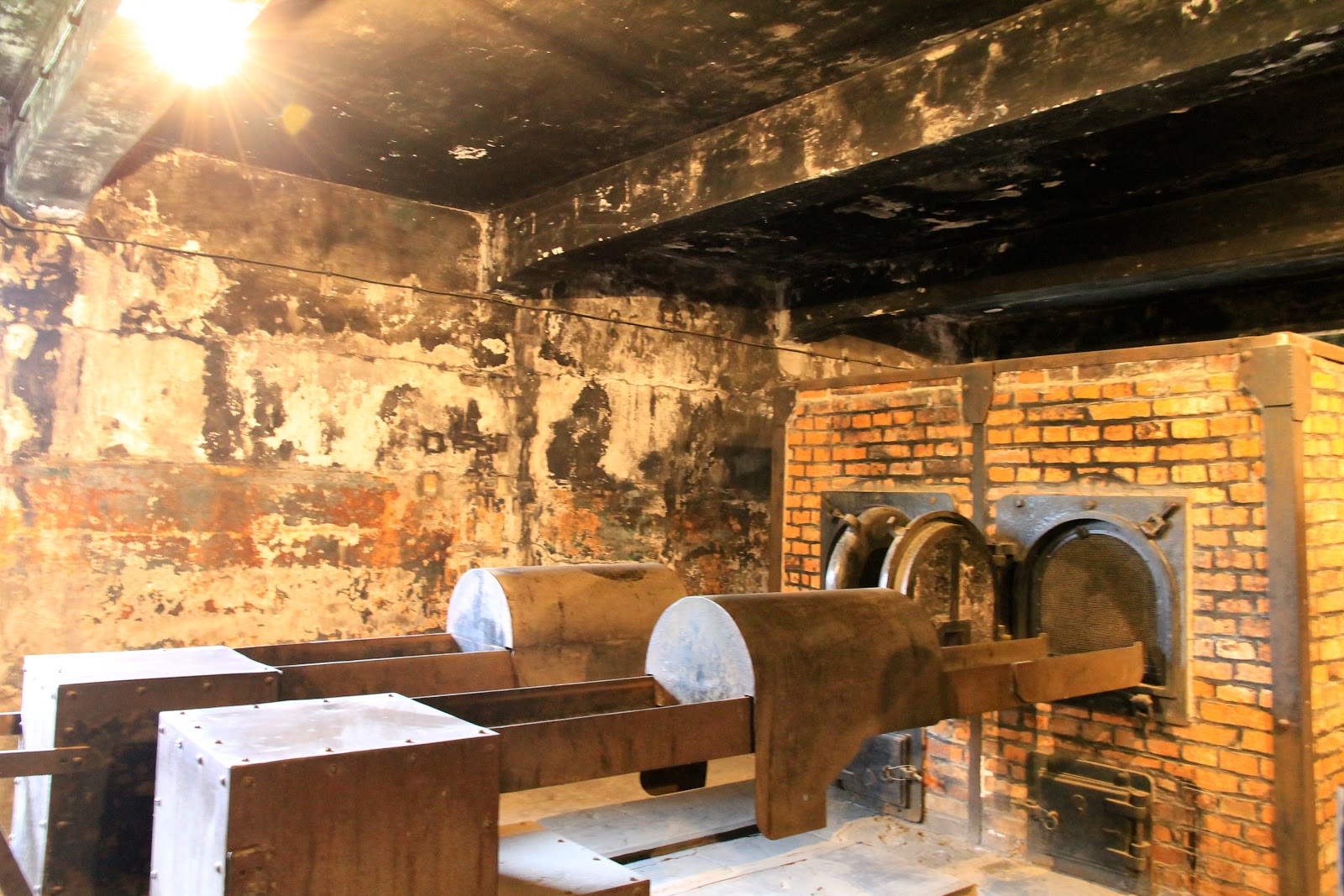
The single gas chamber and crematorium of Auschwitz I still stands because it functioned later as a bomb shelter for the Nazis. Zyklon-B was dropped from holes in the ceiling to murder up to 700 people at a time. "Special" laborers were forced to move the bodies to the adjoining crematorium.
 |
| A replica of the furnaces |
 |
| Used canisters of Zyklon-B |
In 1941, the single crematorium at Auschwitz I was determined inefficient and a second camp was built nearby. Auschwitz II-Birkenau could hold 100,000 prisoners whereas Auschwitz I held no more than 20,000. The majority - probably about 90% - of the victims of Auschwitz were murdered in Birkenau. 1 million people and 9 out of 10 were Jewish.
 |
| Birkenau's guard tower |
 |
| Prisoners on the dividing platform. Women and children to the left, men to the right. |
 |
| The dividing platform with an actual rail car serving as a memorial to the victims. |
 |
| The remains of some barracks, identified by the still-standing chimney stacks |
 |
| Women's barracks |
As bad as Auschwitz I was, Birkenau was worse. The barracks were designed as stables and up to 1,000 could be forced to sleep in just one. This could mean up to 6 people per bunk, including the floor. The grass shown in the pictures is recent. In 1942, there was only mud, barracks packed with people, and smoke from the four crematoria. Sanitation was abysmal at Birkenau and prisoners were allowed two trips the restroom a day.


 |
| A latrine at Birkenau. |
 |
| "On this site stood a wooden barrack where in 1944 more than 200 Jewish children between the ages of 2 and 16 were kept as prisoners. These children, the majority of them twins, were used for criminal medical experiments by the SS doctor Josef Mengele. |
The four crematoria each had the capacity to kill 4,400 people a day. The ashes were spread in fields as fertilizer, were used to make cement blocks and roads in the camps, or were dumped into pits. The Nazis tried to hide evidence of their crimes by destroying the crematoria with explosive as the Red Army approached. The ruins are all that remain.
 |
| "To the memory of the men, women, and children who fell victim to the Nazi genocide. Here lie their ashes. May their souls rest in peace" |
The monument at the back of the camp represents gravestones and a chimney of the crematorium. A poignant realization that the only way to escape was as ash.
Walking on the grounds where more than 1 million men, women, and children were murdered because of their nationality, their beliefs, or their lifestyle had a profound affect on us. It isn't my intention to give a history lesson, but it is my intention to make an impression. Fear of those we don't understand or who are different, the need to blame, and spreading hate. These crimes against humanity are still being committed every day - bullying, racism, homophobia etc. The Holocaust was an extreme result of these ways of thinking. We all have this one life. Why can't it be spent loving each other? The aggressors are only part of the problem as there are people that witness these crimes and do nothing. I've been one of them. I won't be again. I hope you won't be either.